
ls-600a-single-shaft-industrial-shredder-with-d2-blades, ls-600a-single-shaft-industrial-shredder-with-d2-blades, /shredding-machine
EN
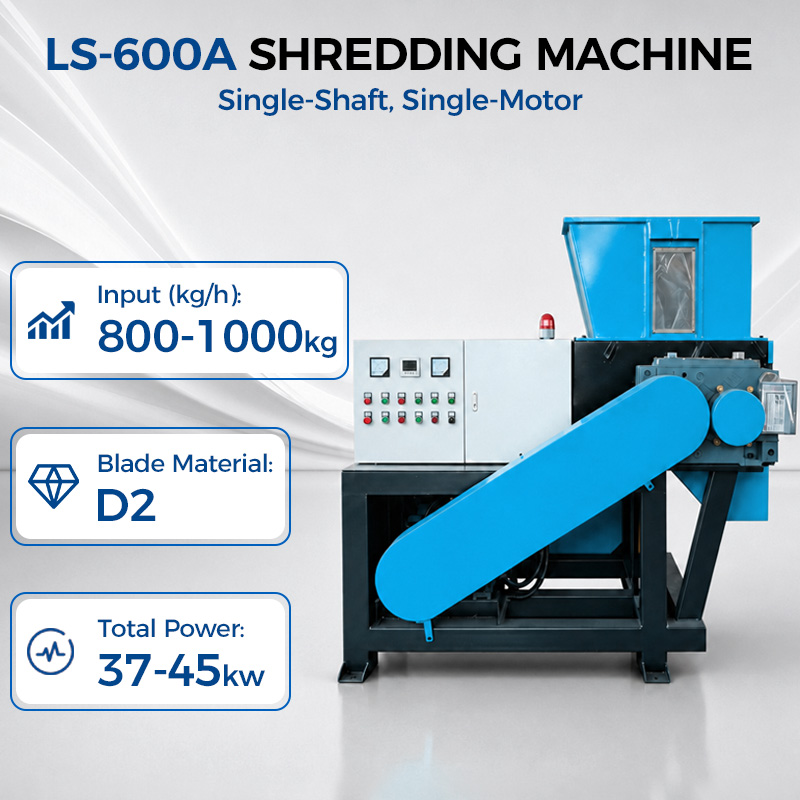
The Lansing LS-600A is a single-shaft, single-motor shredder for industrial material preparation and recycling. Its cutting configuration comprises 36 D2 blades with listed dimensions of 30 × 30 mm, paired with a specified total power range of 37–45 kW and automatic reverse.
With a reference input capacity of 800–1,000 kg/h, the LS-600A provides a size-reduction stage for projects requiring material preparation before further processing. Its single-rotor design offers a different cutting arrangement from twin-shaft machines. Selection should focus on the feedstock, cutting configuration and required output—not motor power alone.
Key Selling Points
| Specification | Details |
| Model | LS-600A |
| Machine Type | Single-Shaft Shredder |
| Drive Configuration | Single Motor |
| Listed Total Power | 37-45 kW |
| Reference Input Capacity | 800-1,000 kg/h |
| Number of Blades | 36 |
| Blade Dimensions | 30x30mm |
| Blade Material | D2 |
| Reverse Function | Automatic Reverse |
| Main Function | Material Size Reduction and Recycling Preparation |
| Machine Weight | 1,700 kg |
| Overall Dimensions, LxWxH | 1,850x1,450x1,800mm |
The LS-600A Single-Shaft Industrial Shredder with D2 Blades is a heavy-duty size-reduction unit engineered for cable, plastic, and mixed waste processing. As an industrial shredder from Hangzhou Lansing Machinery Co., Ltd., this LS-600A combines a single-shaft rotor with D2 blades for long service life. This industrial shredder delivers consistent output for downstream separation. Whether you need an industrial shredder for cable recycling or an LS-600A for plastic reduction, it performs. D2 blades continue to evolve, and this industrial shredder leads the way. Recyclers watching D2 blades will find this LS-600A a smart choice. It also fits any D2 blades program well. As an industrial shredder, this LS-600A proves that D2 blades and structural reliability can coexist.
Hangzhou Lansing Machinery Co., Ltd. provides reliable recycling equipment and customized solutions worldwide. We operate with an affiliated production base and experienced engineering support. Every industrial shredder meets consistent standards. Our LS-600A supports D2 blades across global markets. As D2 blades shift, our industrial shredder stays relevant. This LS-600A also pairs well with any D2 blades line. For buyers seeking an industrial shredder, this LS-600A is a strong choice.
This industrial shredder offers strong features. The LS-600A includes D2 blades for high wear resistance. This industrial shredder uses a single-shaft rotor for uniform output. The LS-600A allows adjustable screen sizes. As D2 blades grow, this industrial shredder uses durable shaft seals. This LS-600A holds throughput during long runs. It also resists wrapping, matching modern D2 blades needs.
Applications for this industrial shredder are wide. Cable recyclers can deploy this LS-600A for pre-shredding. Distributors can add this industrial shredder to their catalogs. Processors aligned with D2 blades will find this LS-600A excellent. Operators can use this industrial shredder for e-waste and mixed plastics. As D2 blades expand, this LS-600A stays versatile.
1. Prepare the Feedstock
Identify the material, remove unsuitable contaminants and prepare pieces within the approved feed dimensions. Keep separate material streams where the next recycling stage requires a defined composition.
2. Introduce Material into the Cutting Area
Load prepared material through the hopper using the feeding procedure specified for the supplied configuration. Match the loading rate to the material's shape, bulk density and cutting behavior.
3. Reduce Material with a Single Cutting Rotor
The motor drives one cutting rotor carrying the cutting elements. Material is reduced through repeated cutting at the rotor's cutting interface, rather than between two interacting cutting shafts. Automatic reverse changes rotor direction according to the machine's control sequence.
4. Collect and Assess the Output
Collect the shredded material for further handling or transfer it to matched downstream equipment. Check the output against the next process's size and feed requirements before establishing the production arrangement.
Single-Rotor Processing for Material Preparation
The LS-600A provides a single-shaft alternative for projects evaluating how incoming scrap should be reduced before the next recycling stage. The cutting approach can be assessed against solid pieces, hollow items and prepared flexible material rather than treating every feedstock as the same load.
Specified D2 Cutting Elements
The blade grade, dimensions and count provide a practical basis for cutter inspection and replacement planning. Using the correct cutter drawing and specification helps keep maintenance aligned with the installed assembly.
Automatic Reversing within the Operating Sequence
Automatic reverse is included as part of the machine's operation. Direction changes are managed through the controls, with activation and timing defined by the supplied instructions.
A Dedicated Industrial Processing Station
The hopper, drive assembly and control cabinet form a floor-standing machine for an organized shredding area. Its layout allows the buyer to plan material staging, loading and output collection around a defined station.
Selection around the Required Output
The rotor and cutter specification supports discussion of the shredded material needed by a granulator, handling system or other downstream process. This places the output requirement alongside throughput when choosing the configuration.
Recycling Workshop Preparation
Size reduction of supported scrap before subsequent handling or recovery. Batches can be organized around the material composition and required downstream treatment.
Plastics Manufacturing Scrap Projects
For approved feedstocks, evaluate the LS-600A for preparing start-up material, molded rejects, pipe offcuts or other production plastics before further granulation or recycling.
Packaging and Paper Waste Projects
Review containers, cartons, board trim and flexible packaging as distinct material streams. Their different shapes and bulk densities influence feeding, collection and the required output form.
Wood, Textile and Rubber Offcut Projects
Prepared production offcuts can be assessed for size reduction before further treatment. Piece length, reinforcement and contaminants are central to selecting an appropriate cutting and feeding arrangement.
Cable and Multi-Stage Recovery Projects
For an approved cable feedstock, assess the shredded output against the receiving granulator and separation equipment. Other material-recovery projects can similarly coordinate shredding with secondary size reduction, screening or sorting.
How is the LS-600A different from a dual-shaft shredder?
It has one cutting rotor driven by a single motor. Dual-shaft machines use two cutting shafts. The LS-600A should therefore be selected by its rotor, feedstock and output requirements rather than treated as a higher-power version of a twin-shaft model.
Does 37–45 kW mean the motor is continuously adjustable between these ratings?
The specification lists a total power range of 37–45 kW; it does not establish continuously variable power or the exact rating of each supplied configuration. Confirm the ordered configuration and its voltage, phase, frequency and starting requirements before installation.
Are 30 × 30 mm blades a guarantee of 30 mm output?
No. These are blade dimensions, not a finished-particle specification. Review the discharge arrangement and output samples against the next process's requirements.
Does the LS-600A include a screen or hydraulic feeding system?
The supplied specification does not identify a screen aperture or hydraulic feeding arrangement. Confirm these details for the ordered machine if the project requires screened output or assisted feeding. They should not be assumed solely because the machine is single-shaft.
What does D2 blade material tell me about service life?
D2 identifies the specified blade material. It does not, by itself, establish a service interval, hardness value or number of usable cutting edges. Follow the cutter specification and maintenance instructions for the actual feedstock.
Can it process solid plastic lumps as well as bottles?
Plastic bottles are an established application. Solid lumps and purgings require separate review because their section thickness and cutting load differ from hollow containers. Provide dimensions, resin information and representative samples when assessing this use.
Can it shred film, textiles or long cable without wrapping?
These materials need feeding and wrapping assessment. Trials should establish whether pre-cutting or a different feeding arrangement is needed. Automatic reverse does not guarantee that flexible material will never wrap around the rotor.
Is 800–1,000 kg/h achievable with every material?
It is a reference input range, not a universal production guarantee. Establish the working rate using representative material and the intended discharge configuration, then match the feeding and receiving equipment to that result.
The Lansing LS-600A is a single-shaft, single-motor shredder for industrial material preparation and recycling. Its cutting configuration comprises 36 D2 blades with listed dimensions of 30 × 30 mm, paired with a specified total power range of 37–45 kW and automatic reverse.
With a reference input capacity of 800–1,000 kg/h, the LS-600A provides a size-reduction stage for projects requiring material preparation before further processing. Its single-rotor design offers a different cutting arrangement from twin-shaft machines. Selection should focus on the feedstock, cutting configuration and required output—not motor power alone.
Key Selling Points


 EN