
le-1200-electrostatic-copper-plastic-separator-with-dust-collection, le-1200-electrostatic-copper-plastic-separator-with-dust-collection, /electrostatic-separator
EN
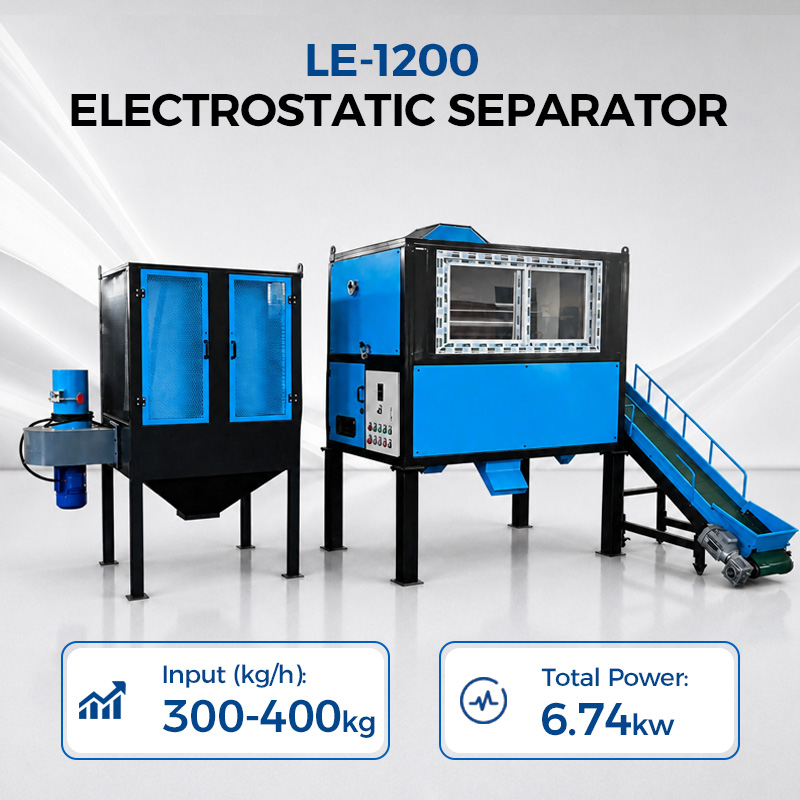
The Lansing LE-1200 is an electrostatic separator for fine copper-plastic separation after cable granulation and air separation. It treats the remaining mixed fraction, helping cable recyclers recover fine copper and reduce nonmetal contamination in the collected copper product.
With 6.74 kW total power and a reference input capacity of 300–400 kg/h, the LE-1200 combines vibratory material distribution, high-voltage corona separation and a separate dust-collection box. It can be paired with Lansing 400C or 600S copper wire granulators, or incorporated into a line with upstream shredding, granulation and final electrostatic separation.
Key Selling Points
| Specification | Details |
| Model | LE-1200 |
| Machine Type | Electrostatic Separator |
| Total Power | 6.74kW |
| Reference Input Capacity | 300-400 kg/h |
| Primary Feed | Liberated copper-plastic particles after granulation and air separation |
| Separation Method | High-voltage corona and electrostatic separation |
| Material Distribution | Vibratory feeding |
| Dust Collection | Separate dust-collection box included |
| Main Unit Dimensions, LxWxH | 2,500x1,750x2,500mm |
| Dust Box Dimensions, LxWxH | 1,000x1,000x1,950 mm |
| Listed Machine Weight | 1,200kg |
| Recommended Granulator Pairings | Lansing 400C and 600S |
The input rating describes the mixture entering the LE-1200, not recovered copper output or the capacity of the entire recycling line. Installation space must accommodate both units, their connecting ductwork and access for operation, collection and servicing.
The LE-1200 Electrostatic Copper-Plastic Separator with Dust Collection is a precision recycling unit engineered for separating copper from plastic in waste cable processing. As a copper-plastic separator from Hangzhou Lansing Machinery Co., Ltd., this electrostatic separator combines a high-voltage electrostatic field with an integrated dust collection system. This copper-plastic separator delivers clean copper granules with minimal plastic contamination. Whether you need a copper-plastic separator for cable recycling or an electrostatic separator for mixed metal-plastic scrap, it performs. Dust collection continues to evolve, and this electrostatic separator leads the way. Recyclers watching dust collection will find this copper-plastic separator a smart choice. It also fits any dust collection program well. As an electrostatic separator, this copper-plastic separator proves that dust collection and separation purity can coexist.
Hangzhou Lansing Machinery Co., Ltd. provides reliable recycling equipment and customized solutions worldwide. We operate with an affiliated production base and experienced engineering support. Every copper-plastic separator meets consistent standards. Our electrostatic separator supports dust collection across global recycling projects. As dust collection shifts, our copper-plastic separator stays relevant. This electrostatic separator also pairs well with any dust collection line. For buyers seeking a copper-plastic separator, this electrostatic separator is a strong choice.
| Feedstock Source | Material Presented to the LE- 1200 | Separation Task |
| Electrical Installation Wire | Granulated copper-insulation mixture after air separation | Refine the copper fraction and recover residual fine copper |
| Household-Appliance Wiring | Prepared wire granules with copper and plastic released from each other | Separate remaining conductive and nonconductive particles |
| Network Cable | Crushed and liberated copper- plastic particles | Fine separation of the mixed fraction |
| Automotive Wiring | Dismantled and granulated cable material | Recover copper from the prepared mixed stream |
| Motor, Air- Conditioning and Transformer Wire | Processed wire particles with the conductor released from its insulation | Separate the conductive fraction from remaining nonmetal material |
| Aluminum Composite Panels and Blister Packaging | Crushed material with aluminum released from the plastic or other nonmetal layers | Conductive aluminum/nonconductive fraction separation |
| Circuit Boards | Dismantled and crushed metal/nonmetal particles | Recover a conductive-metal fraction from the nonmetal substrate |
Motor, transformer and appliance applications refer to processed wiring, not feeding complete motors, transformers or appliances into the machine. Empty packaging and remove batteries, fluids and other hazardous components during upstream preparation. Conductivity separation does not automatically sort different metals from one another or distinguish every plastic grade.
An Additional Recovery Stage after Air Separation
The LE-1200 targets material that still contains both copper and plastic after the primary separation step. This gives it a specific role in the line: improving the quality of the collected copper stream while recovering metal that remains in the mixed fraction.
Feed Distribution Supports Fine Separation
Vibratory distribution controls how particles reach the drum. Even feeding is especially important when treating a stream with small copper particles, where simply increasing the loading rate can undermine the separation result.
Dust Collection Is Part of the Configuration
The separate dust box is included in the shown equipment configuration, rather than left as an unspecified add-on. Its own enclosure and discharge arrangement allow collected dust to be handled separately from the main product streams.
More Than One Route to a Complete Line
A 400C or 600S granulator can supply the prepared mixture. For a broader line, Lansing also shows a 600-series dual-shaft, dual-motor shredder ahead of the 600S granulator and LE-1200. This separates three tasks clearly: initial size reduction, granulation and fine electrostatic separation.
A Clear Basis for Product-Quality Checks
Both outlets matter. Copper-product quality is assessed by the nonmetal contamination in the metal-rich stream; recovery is assessed by the copper still leaving with the other fractions. Keeping those checks separate prevents a visually clean copper sample from being mistaken for proof that all incoming copper has been recovered.
Upgrading an Existing Cable Recycling Line
Granulation → air separation → remaining copper-plastic mixture → LE-1200 → separate collection of the refined fractions. This route adds a fine-separation stage without asking the electrostatic separator to perform the granulator's size-reduction work.
400C or 600S Granulator Pairing
Use either of the recommended granulator models to prepare and air-separate the cable material, then send the selected mixed fraction to the LE-1200. Transfer equipment and loading arrangements should match the actual stream being processed, not just the granulator's total input rating.
Shredding, Granulation and Fine Separation
600-series dual-shaft, dual-motor shredder → 600S copper wire granulator → LE-1200 electrostatic separator. This recommended combination provides successive stages for scrap preparation and copper-plastic recovery. It is a line configuration option, not a statement that all machines are included with the separator.
Aluminum-Plastic and Circuit-Board Recycling
Upstream dismantling and crushing → liberated metal/nonmetal particles → electrostatic separation → separate recovery routes. Aluminum-plastic packaging and panel waste produce an aluminum-bearing fraction; prepared circuit-board material produces a conductive-metal fraction rather than chemically refined or individually sorted metals.
My copper wire granulator already has air separation. Why add the LE-1200?
Air separation and electrostatic separation use different material properties. The LE-1200 uses electrical-conductivity differences to treat the copper-plastic mixture remaining after air separation. It is useful when that stream still contains fine copper worth recovering or when nonmetal contamination needs to be reduced in the copper product. It complements the air separator rather than replacing the granulator.
Can I feed whole cables, complete motors or uncrushed panels?
No. The LE-1200 requires prepared particles with metal released from insulation or other nonmetal layers. Granulate cable, dismantle relevant components and crush composite products before this stage. If copper and plastic remain attached in one fragment, further liberation is needed before they can be separated as independent particles.
Can a 300–400 kg/h separator be used with a higher-capacity granulator?
Yes, when the selected stream sent to the separator remains within its working capacity. For example, the electrostatic stage may receive the mixed fraction after air separation rather than all material entering the granulator. If the full stream exceeds the LE-1200's capacity, provide a separate buffer and controlled transfer arrangement or size the separation stage differently. The separator's rating is not the throughput of the complete line.
Is the dust box included, and does it make the system completely dust-free?
The LE-1200 configuration includes a separate dust-collection box. It is connected to the separator for dust handling, but its presence is not a zero-emission, filtration-efficiency or explosion-protection certification. Keep its discharge and service access clear, and arrange safe handling of the collected dust appropriate to the processed material.
The Lansing LE-1200 is an electrostatic separator for fine copper-plastic separation after cable granulation and air separation. It treats the remaining mixed fraction, helping cable recyclers recover fine copper and reduce nonmetal contamination in the collected copper product.
With 6.74 kW total power and a reference input capacity of 300–400 kg/h, the LE-1200 combines vibratory material distribution, high-voltage corona separation and a separate dust-collection box. It can be paired with Lansing 400C or 600S copper wire granulators, or incorporated into a line with upstream shredding, granulation and final electrostatic separation.
Key Selling Points


 EN