
h120-4-2120mm-combined-automatic-wire-stripping-machine, h120-4-2120mm-combined-automatic-wire-stripping-machine, /wire-stripping-machine
EN

Small-Wire Positions and Large-Cable Adjustment in One Machine
The Lansing H120-4 combines fixed wire-stripping openings with an adjustable large-cable opening in one floor-standing machine. Its specified 2–120 mm outside-diameter range accommodates suitable smaller wires and larger scrap cables through the appropriate stripping positions.
A 3kW geared motor powers the feeding system. Five round openings, one square opening, and one adjustable opening provide different setup options, with 11 blades across the stripping assembly.
Key Selling Points
11 Blades Total · Cabinet-Style Base · 208 kg Machine Weight
LANSING MACHINERY presents the H120-4 2–120mm Combined Automatic Wire Stripping Machine, a high-efficiency solution engineered for modern recycling and industrial processing needs. Designed to address the growing demand for reliable automatic wire stripper systems, this automatic wire stripper model integrates precision mechanics, advanced control logic, and automatic wire stripper scalable throughput for a wide array of cable recycling and metal recovery tasks. The H120-4 automatic wire stripper is built to host demanding workflows in factories, automatic wire stripper recycling centers, and automatic wire stripper salvage operations where speed, consistency, and material value recovery are critical
The H120-4 2–120mm Combined Automatic Wire Stripping Machine is purpose-built to process a broad diameter range of insulated conductors, from thin wires to bulky cables with diameters up to 120 mm. As an automatic wire stripper, it automates the stripping, cutting, and separation stages traditionally handled by manual operators, thereby reducing labor costs and improving safety
At the heart of the H120-4 lies a compact yet robust drivetrain and blade assembly designed for longevity under heavy-duty use. Advanced servo controls synchronize feed speed with blade actuation, automatic wire stripper enabling precise removal of insulation without damaging conductive cores
The machine’s tooling uses hardened, automatic wire stripper replaceable blades with anti-friction coatings to extend service life. Quick-change blade mounts reduce downtime during maintenance or tool swaps
Recovering valuable metals from insulated cables not only yields economic returns but also reduces environmental impact. The H120-4 automatic wire stripper helps recycling facilities maximize copper and aluminum salvage rates by delivering clean, undamaged conductors ready for downstream processing. Cleaner automatic wire stripper metal streams lower contamination risks, improve smelter yields, and automatic wire stripper reduce the energy required for reprocessing
As part of LANSING MACHINERY’s product family, the H120-4 automatic wire stripper is offered with multiple customization options. Customers automatic wire stripper can choose from different feed systems, blade configurations, and automation levels depending on throughput targets and automatic wire stripper material profiles
1. A 2–120 mm Working Range
The specified range extends from smaller insulated wires to large cables, using the appropriate processing position for each material.
2. Combined Fixed and Adjustable Openings
Two types of stripping setup are incorporated into one machine, providing options for different cable diameters and constructions.
3. Five Round Wire-Stripping Holes
Multiple round openings allow suitable wires to be matched to different feeding positions.
4. One Square Wire-Stripping Hole
A separate square opening provides an additional option for suitable cable profiles, subject to material fit and cutting requirements.
5. Adjustable Large-Cable Position
The adjustable opening accommodates larger cable by allowing the setup to be matched to its diameter and covering thickness.
6. 3kW Geared Drive
The geared motor powers the feeding mechanism at a reduced rotational speed. Actual feeding performance depends on the complete mechanism and cable characteristics.
7. Eleven-Blade Assembly
Eleven blades serve the machine’s stripping positions. Their arrangement supports the combined processing layout.
8. Integrated Cabinet Design
Both stripping sections share one floor-standing machine body, helping organize varied cable processing within a single installation area.
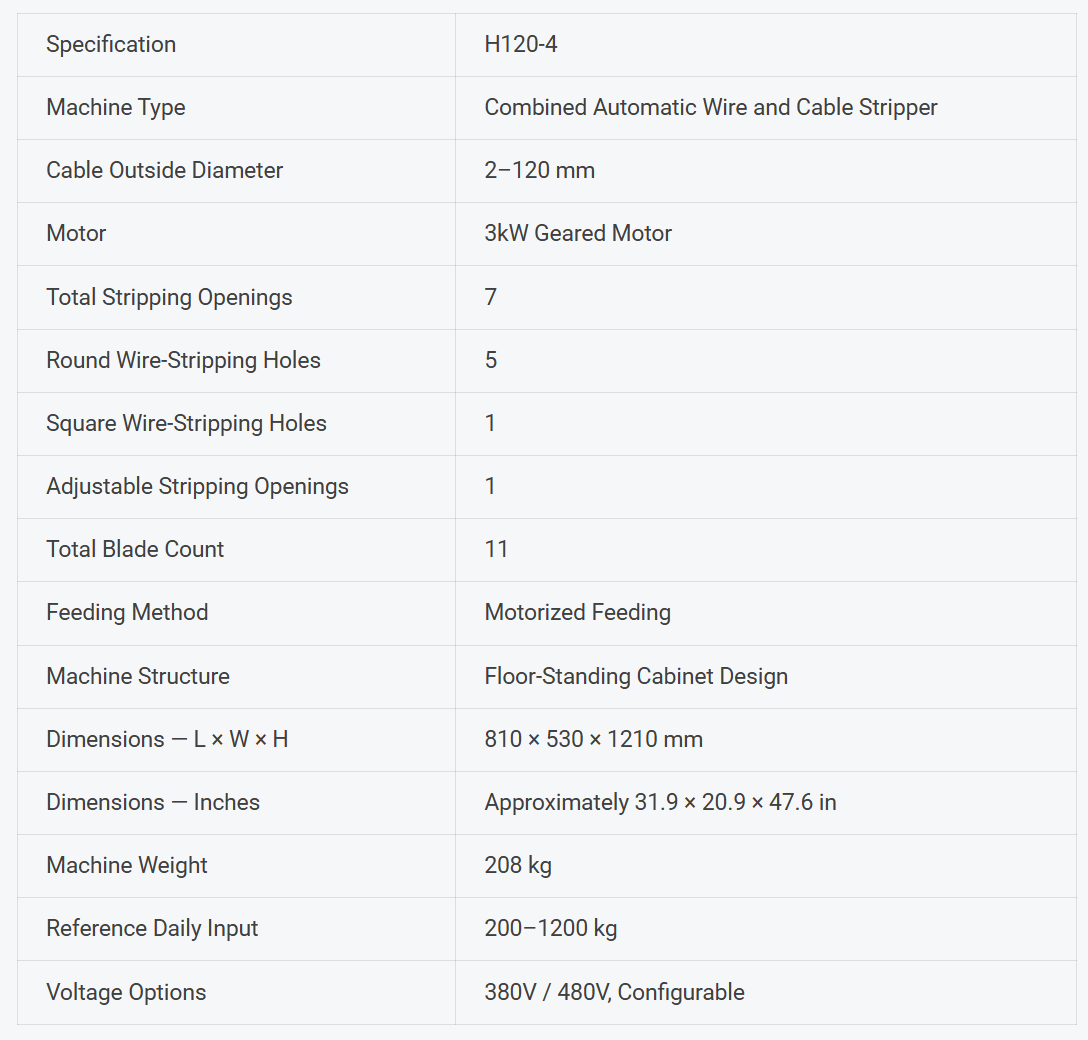
The working range refers to cable outside diameter, including insulation.
Daily input is a reference weight of incoming cable, not recovered copper weight. Actual output depends on cable construction, preparation, machine setup, operator handling, and working hours.
Four Steps to Match the Machine to Your Cable
1. Sort by Size and Construction
Measure the outside diameter and inspect the cable cross-section. Group similar materials before processing.
2. Select the Appropriate Section
Choose a suitable fixed opening or the adjustable stripping position. Disconnect power before setting the opening and cutting depth according to the operating manual.
3. Test a Short Sample
Run a short length with guards in place. Inspect the insulation cut and underlying material before continuing.
4. Strip and Collect
Process the batch with the checked settings. Remove opened insulation as needed and collect the conductor and coverings separately.
Use only disconnected scrap cable verified safe to handle. Support long or heavy cable, and stop and disconnect machine power before clearing jams or changing settings.
Smaller Electrical Wire
Suitable insulated wire within the lower part of the machine’s working range, matched to an appropriate fixed opening.
Appliance and Equipment Wire
Suitable wiring collected during repair, replacement, or equipment dismantling.
Medium-Diameter Sheathed Cable
Electrical cable requiring controlled opening of the covering before conductor recovery.
Large Power Cable
Suitable large-diameter cable processed through the adjustable stripping position.
Mixed-Size Recycling Batches
Scrap containing different cable sizes, sorted and processed through the appropriate section of the machine.
Material Compatibility
Cable diameter alone does not establish suitability. Insulation hardness, jacket thickness, conductor structure, shielding, and metallic armor affect the cutting requirements.
Multi-core cables may require outer-jacket removal followed by separate processing of individual cores. Armored constructions require confirmation of blade suitability and the intended removal stage.
What is the main feature of the H120-4?
It combines fixed wire-stripping holes with an adjustable large-cable opening in one machine, providing different setups for varied cable sizes.
Is the working range 1–120 mm or 2–120 mm?
The supplied specification lists 2–120 mm in outside diameter, including insulation. This is the range used for this configuration.
How are the seven openings arranged?
The machine has five round wire-stripping holes, one square wire-stripping hole, and one adjustable stripping opening.
Does every opening cover the full diameter range?
No. The 2–120 mm range applies to the machine as a whole. Individual openings have different material-fit and setup requirements.
Can both stripping sections operate simultaneously?
The combined layout does not establish simultaneous feeding capability. Follow the operating manual for the permitted feeding method.
How many blades does it have?
The specification lists 11 blades across the stripping assembly. This does not mean all 11 engage one cable at the same time.
How does H120-4 differ from H120-3?
The H120-3 lists two adjustable openings and four circular blades for a 10–120 mm range. The H120-4 combines six fixed openings with one adjustable opening, lists 11 blades, and extends the specified range down to 2 mm.
Can it process fine stranded wire?
Suitable wire may be processed through a matched opening, but thin insulation and fine strands require careful adjustment and sample testing. Diameter alone does not confirm compatibility.
Does it remove insulation completely automatically?
Feeding and cutting are motorized. The operator still prepares and introduces the material, and additional peeling may be required.
Can it process armored cable?
The machine’s diameter range does not establish a universal armor-cutting capability. Armor material, thickness, and the intended stripping stage must be checked against the cutting configuration.
Compare Lansing H120 Cable Strippers
| Feature | H120-1 | H120-2 | H120-3 | H120-4 |
| Cable Outside Diameter | 20–120 mm | 20–120 mm | 10–120 mm | 2–120 mm |
| Motor | 3kW Geared | 3kW Geared | 3kW Geared | 3kW Geared |
| Stripping Openings | 1 Adjustable | 1 Adjustable | 2 Adjustable | 5 Round + 1 Square + 1 Adjustable |
| Blade Count | 2 Circular Blades | 2 Circular Blades | 4 Circular Blades | 11 Blades |
| Machine Weight | 126 kg | 210 kg | 223 kg | 208 kg |
| Reference Daily Input | 800–2000 kg | 500–4000 kg | 800–2000 kg | 200–1200 kg |
| Listed Voltage Options | 220V / 380V | 220V / 380V | 220V / 380V | 380V / 480V |
| Main Selection Point | Adjustable large-cable setup | Cabinet base with upper and lower blades | Two adjustable positions | Combined fixed-hole and adjustable stripping |
Where the H120-4 Fits
The H120-4 is suited to recycling operations receiving a broad mix of cable sizes. Its fixed openings provide options for smaller wire, while the adjustable section accommodates suitable larger cable.
For work focused mainly on large cables, compare the H120 models by cutting layout and sample results. The H120-4’s main distinction is its combined processing range, rather than a guaranteed increase in throughput.
Small-Wire Positions and Large-Cable Adjustment in One Machine
The Lansing H120-4 combines fixed wire-stripping openings with an adjustable large-cable opening in one floor-standing machine. Its specified 2–120 mm outside-diameter range accommodates suitable smaller wires and larger scrap cables through the appropriate stripping positions.
A 3kW geared motor powers the feeding system. Five round openings, one square opening, and one adjustable opening provide different setup options, with 11 blades across the stripping assembly.
Key Selling Points
11 Blades Total · Cabinet-Style Base · 208 kg Machine Weight


 EN