
h120-3-10120mm-adjustable-armored-cable-stripping-machine, h120-3-10120mm-adjustable-armored-cable-stripping-machine, /wire-stripping-machine
EN
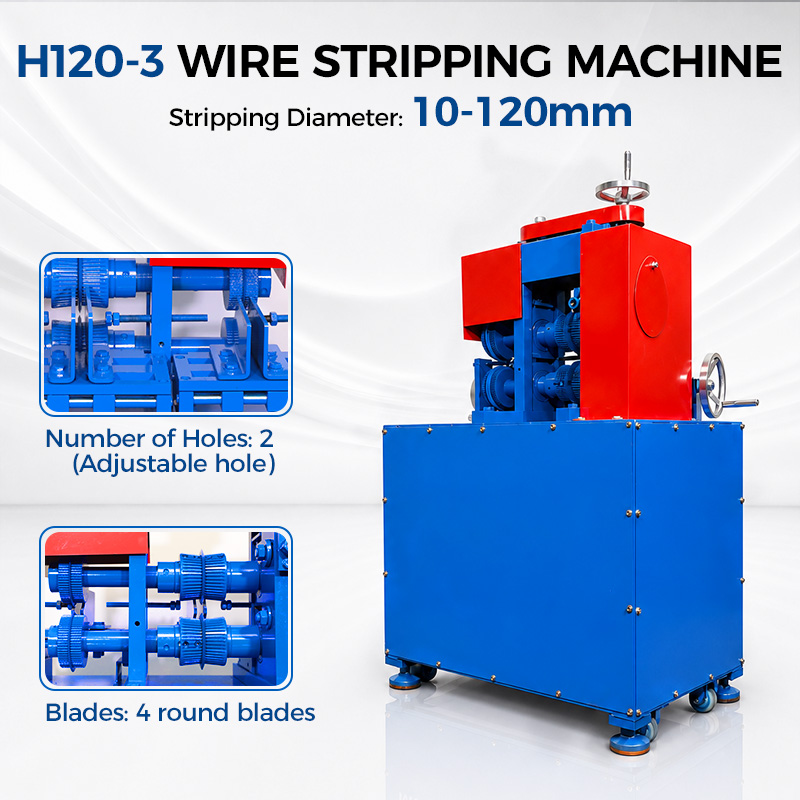
Two Adjustable Openings for Varied Cable Sizes
The Lansing H120-3 is a floor-standing electric cable stripping machine for suitable scrap cables from 10–120 mm in outside diameter. It combines a 3kW geared motor with two adjustable stripping openings and four circular blades to open cable coverings for material recovery.
Designed for large sheathed cables and suitable armored constructions, the H120-3 offers a wider diameter range than the H120-1 and H120-2, extending the lower limit to 10 mm.
Key Selling Points
Hangzhou Lansing Machinery presents the H120-3 10–120mm Adjustable Armored Cable Stripping Machine, a precision-engineered solution designed to meet the demanding needs of modern cable recycling and industrial cable processing. Built on decades of hands-on experience in waste cable and metal recycling, the H120-3 integrates robust mechanics, intelligent adjustability, and operator-focused safety to deliver consistent, high-yield performance for a wide range of cable types
Product overview
The H120-3 is an armored cable stripping machine tailored to process cables with diameters from 10 to 120 mm. This adjustable cable stripper is engineered for armored cables, multi-core power cables, and heavy-duty industrial wiring, providing a versatile platform for recycling yards, cable processors, and manufacturers seeking efficient industrial cable processing
Key features and technical advantages
- Wide diameter range: The H120-3 accommodates cable sizes from 10–120 mm, making it a highly adaptable adjustable cable stripper for diverse materials encountered in cable recycling equipment operations. This wide range reduces the need for multiple machines and simplifies workflow planning for industrial cable processing facilities
Why choose LANSING MACHINERY’s H120-3
With a strong track record in manufacturing and R&D, LANSING MACHINERY combines industry experience with customer-focused support to deliver dependable cable recycling equipment. The H120-3 armored cable stripping machine reflects the company’s commitment to practical innovation, offering an adjustable cable stripper optimized for industrial cable processing environments
1. A 10–120 mm Working Range
Handle suitable medium and large cables within one machine’s specified range, including diameters below the H120-1 and H120-2 minimum of 20 mm.
2. Two Adjustable Openings
Two stripping positions provide additional setup options for different cable sizes and constructions.
3. Four Circular Blades
Four blades serve the stripping assembly, opening suitable coverings for subsequent removal.
4. 3kW Geared Motor
The geared drive powers cable feeding at a reduced rotational speed. Actual feeding capability depends on the mechanism, settings, and cable characteristics.
5. Adjustable Cutting Setup
Match the opening and blade depth to the intended layer. A short sample helps establish settings before processing a batch.
6. Powered Feeding
Motorized feeding reduces the need to pull cable manually through the cutting section.
7. Cabinet-Style Construction
The cabinet base supports the stripping assembly and incorporates the lower drive area in one floor-standing machine.
| Specification | H120-3 |
| Machine Type | Automatic Scrap Cable Stripping Machine |
| Cable Outside Diameter | 10–120 mm |
| Motor | 3kW Geared Motor |
| Stripping Openings | 2 Adjustable Openings |
| Blade Count | 4 Circular Blades |
| Feeding Method | Motorized Feeding |
| Machine Structure | Floor-Standing Cabinet Design |
| Dimensions — L × W × H | 760 × 470 × 1300 mm |
| Dimensions — Inches | Approximately 29.9 × 18.5 × 51.2 in |
| Machine Weight | 223 kg |
| Reference Daily Input | 800–2000 kg |
| Voltage Options | 220V / 380V, Configurable |
The working range refers to cable outside diameter, including insulation.
Daily input is a reference weight of incoming cable, not recovered copper weight. Actual output depends on cable construction, preparation, machine setup, operator handling, and working hours.
Four Steps to Set Up Your Stripping Job
1. Inspect the Cable
Measure the outside diameter and examine the cross-section. Identify the jacket, insulation, armor, shielding, and internal cores before selecting a processing method.
2. Select and Adjust the Stripping Position
Disconnect machine power before setup. Choose the appropriate opening and adjust the cutting depth according to the material and operating manual.
3. Test a Short Section
Support the cable and run a short trial with guards in place. Check that the intended covering is opened without excessive cutting into the underlying material.
4. Process and Separate
Continue with the checked settings. Remove opened coverings and sort the materials. Reassess the setup before processing another layer or cable type.
Use only disconnected scrap cable verified safe to handle. Stop and disconnect machine power before clearing jams, adjusting blades, or servicing.
Large Sheathed Power Cable
Suitable electrical cables with substantial outer coverings requiring controlled opening before conductor recovery.
Suitable Armored Cable
Armored constructions matched to the machine’s blade capability and intended stripping stage. Armor material and thickness require assessment.
Multi-Core Electrical Cable
Suitable cable requiring outer-jacket removal to access internal cores. Individual core insulation may need separate processing.
Medium-Diameter Cable
Suitable material from 10 mm upward, extending the application range below the minimum diameter specified for H120-1 and H120-2.
Cable Replacement and Dismantling Scrap
Sorted cable lengths generated during electrical maintenance, infrastructure renewal, and equipment dismantling.
Material Compatibility
Outside diameter alone does not confirm suitability. Jacket hardness, metallic layers, fillers, and conductor arrangement affect the required cutting setup and removal sequence.
What cable sizes can the H120-3 process?
The specified range is 10–120 mm in outside diameter, including the cable covering. Select the appropriate opening and settings for each material.
What distinguishes it from H120-1 and H120-2?
The H120-3 lists two adjustable openings and four circular blades, compared with one opening and two blades on the other two models. Its specified minimum diameter is also lower: 10 mm instead of 20 mm.
Do both openings cover the entire 10–120 mm range?
The specification gives the working range for the machine as a whole. The applicable range and setup for each opening should follow the machine instructions.
Can two cables be fed simultaneously?
The presence of two openings does not establish simultaneous feeding capability. Follow the permitted feeding method in the operating manual.
Do all four blades cut the same cable at once?
The specification identifies four blades across the assembly. It does not state that all four engage one cable simultaneously.
Can the H120-3 process armored cable?
It is intended for suitable armored cable applications. Armor material, thickness, and the layer to be removed must be matched to the cutting capability.
Does it remove armor, insulation, and the conductor in one pass?
Not necessarily. Different layers may require staged cutting and manual removal. A cable sample helps establish the appropriate sequence.
Can it process multi-core cable?
Suitable constructions may be processed for outer-jacket removal. This does not automatically strip insulation from each internal core.
Is it faster than H120-2 because it has more blades?
More blades and openings provide a different setup, but do not establish a higher processing rate. Throughput depends on the material and complete workflow.
What does 800–2000 kg daily input mean?
It is a reference range for incoming cable weight, including coverings. It is not a guaranteed production rate or recovered copper weight.
What electrical supply is required?
The specification lists configurable 220V and 380V options. Voltage, frequency, phase, and circuit capacity must match the delivered machine.
How much installation space is needed?
The machine measures 760 × 470 × 1300 mm. Additional space is needed for cable support, operator access, and collection. Appropriate handling is required for its 223 kg weight.
What routine maintenance is needed?
Inspect blades, feeding components, adjustment mechanisms, drive components, and fasteners according to the operating manual. Disconnect power before cleaning or maintenance and reinstall guards before operation.
Compare Lansing H120 Cable Strippers
| Feature | H120-1 | H120-2 | H120-3 |
| Cable Outside Diameter | 20–120 mm | 20–120 mm | 10–120 mm |
| Motor | 3kW Geared Motor | 3kW Geared Motor | 3kW Geared Motor |
| Adjustable Openings | 1 | 1 | 2 |
| Circular Blades | 2 | 2 | 4 |
| Machine Structure | Open Support Frame | Cabinet-Style Base | Cabinet-Style Base |
| Dimensions — L × W × H | 750 × 600 × 1050 mm | 700 × 550 × 1250 mm | 760 × 470 × 1300 mm |
| Machine Weight | 126 kg | 210 kg | 223 kg |
| Reference Daily Input | 800–2000 kg | 500–4000 kg | 800–2000 kg |
| Main Selection Point | Single adjustable setup for large cable | Cabinet construction with upper and lower blades | Lower minimum diameter and two adjustable positions |
Where the H120-3 Fits
The H120-3 suits operations seeking two adjustable stripping positions and a working range extending down to 10 mm. Its four circular blades and cabinet layout distinguish it from the other H120 models.
Choose according to cable construction, the required removal stages, and sample results. Blade count and reference daily input figures alone do not establish which machine will process a particular cable most effectively.
Two Adjustable Openings for Varied Cable Sizes
The Lansing H120-3 is a floor-standing electric cable stripping machine for suitable scrap cables from 10–120 mm in outside diameter. It combines a 3kW geared motor with two adjustable stripping openings and four circular blades to open cable coverings for material recovery.
Designed for large sheathed cables and suitable armored constructions, the H120-3 offers a wider diameter range than the H120-1 and H120-2, extending the lower limit to 10 mm.
Key Selling Points


 EN