
h120-2-20120mm-geared-automatic-cable-stripping-machine, h120-2-20120mm-geared-automatic-cable-stripping-machine, /wire-stripping-machine
EN
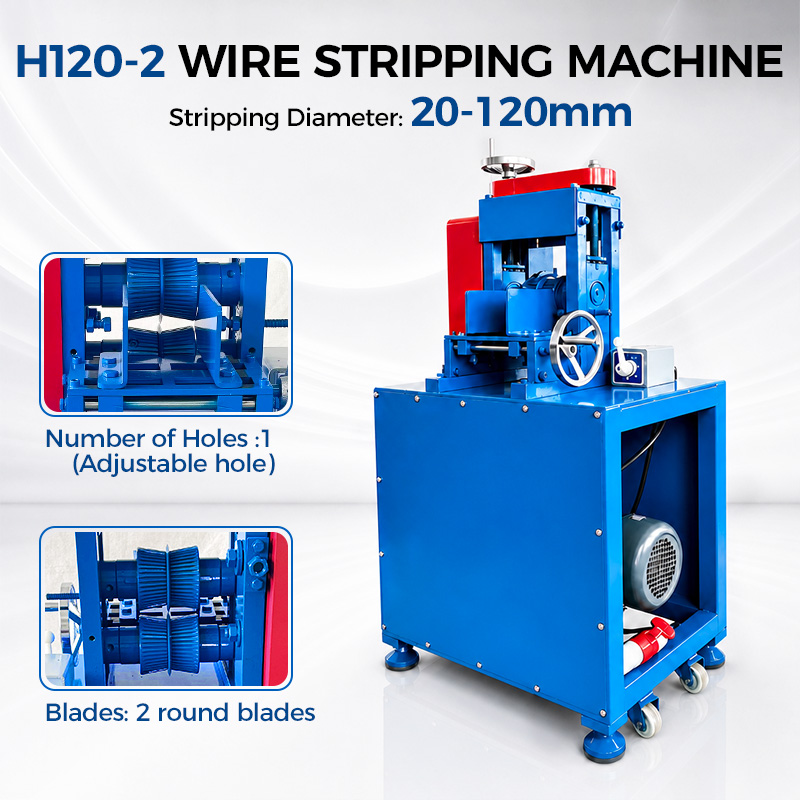
Upper and Lower Blades for Large-Cable Stripping
The Lansing H120-2 is a floor-standing cable stripping machine for suitable scrap electrical cables from 20–120 mm in outside diameter. A 3kW geared motor powers cable feeding, while upper and lower circular blades open the covering for removal.
One adjustable feed opening allows the cutting setup to be matched to different large-cable sizes. The 210 kg cabinet-style machine provides a dedicated platform for scrap cable processing and conductor recovery.
Key Selling Points
LANSING MACHINERY proudly presents the H120-1 20–120mm Automatic Armored Cable Stripping Machine, a robust and precise solution engineered for contemporary cable recycling automation and industrial cable processing needs. Designed to meet demanding throughput and recovery requirements, the H120-1 armored cable stripper redefines efficiency in metal recovery equipment for facilities focused on extracting valuable conductors from armored and sheathed cables. With decades of experience behind the brand, this machine combines automated workflow, durable components, and smart design to deliver consistent, high-yield performance for recycling centers, scrap yards, and industrial processors
Product Overview and Core Capabilities
The H120-1 operates across a wide cable diameter range from 20mm to 120mm, enabling operators to process a comprehensive spectrum of armor types and cable constructions. As an armored cable stripper, the H120-1 is capable of stripping concentric, corrugated, and wire-armored cables as well as multi-layered power and control cables. The system integrates a high-torque feed mechanism, precision cutting assembly, and automated strip length control to optimize recovery rates while minimizing damage to underlying conductors
Integration with Recycling Workflows
One of the H120-1’s strengths is its compatibility with broader recycling workflows. Its output—cleanly stripped conductors and separated armor fragments—feeds directly into metal recovery equipment such as density separators, Granulators, or balers. By serving as a reliable frontend solution in a cable recycling automation line, the armored cable stripper armored cable stripper enhances the efficiency of the entire process chain, thereby improving overall recovery economics
Maintenance, Serviceability, and Lifecycle Support
LANSING MACHINERY designs the H120-1 with maintainability in mind. Routine service items are readily accessible, and critical wear components are modular to allow swift replacement. The armored cable stripper machine’s robust construction minimizes unplanned maintenance, supporting extended operational cycles crucial for metal recovery equipment investments
Economic and Environmental Benefits
Deploying the H120-1 as part of a cable recycling automation initiative delivers measurable economic returns: higher recovery yields, reduced labor costs, and faster processing times. Environmentally, efficient stripping reduces residue and contamination, making downstream metal recovery more efficient and minimizing landfill waste
Why Choose the H120-1 from LANSING MACHINERY
When selecting an armored cable stripper for heavy-duty industrial cable processing, the H120-1 stands out for its balance of automation, versatility, and durable engineering. LANSING MACHINERY leverages decades of integrated manufacturing and application know-how to deliver a machine that is easy to integrate, simple to operate, and economical to maintain
1. A 20–120 mm Cable Range
Process suitable large-diameter electrical cables that exceed the working range of smaller wire stripping machines.
2. Upper and Lower Circular Blades
Two blades provide cutting positions above and below the cable, helping open the covering for subsequent removal.
3. One Adjustable Feed Opening
Set the opening to the incoming cable instead of selecting among fixed-size feed holes.
4. 3kW Geared Motor
The geared drive powers the feeding mechanism at a reduced rotational speed. Actual feeding capability depends on the complete mechanism and cable construction.
5. Adjustable Cutting Depth
Match the cut to the jacket or insulation layer being removed. Sample testing helps establish a suitable setting before batch processing.
6. Powered Cable Feeding
Motorized feeding reduces the need to pull each cable length manually through the cutting position.
7. Cabinet-Style Base
The lower cabinet incorporates the drive area and supports the stripping assembly in a defined floor-standing structure.
8. Compact Base Dimensions
The 700 × 550 mm base helps organize the installation area. Additional clearance is required for cable support, operator access, and collection.
| Specification | H120-2 |
| Machine Type | Automatic Large-Cable Stripping Machine |
| Cable Outside Diameter | 20–120 mm |
| Motor | 3kW Geared Motor |
| Feed Openings | 1 Adjustable Opening |
| Blade Count | 2 Circular Blades |
| Blade Arrangement | Upper and Lower |
| Feeding Method | Motorized Feeding |
| Machine Structure | Floor-Standing Cabinet Design |
| Dimensions — L × W × H | 700 × 550 × 1250 mm |
| Dimensions — Inches | Approximately 27.6 × 21.7 × 49.2 in |
| Machine Weight | 210 kg |
| Reference Daily Input | 500–4000 kg |
| Voltage Options | 220V / 380V, Configurable |
The working range refers to cable outside diameter, including insulation.
Daily input is a reference weight of incoming cable, not recovered copper weight. Actual output depends on cable construction, preparation, machine setup, operator handling, and working hours.
Four Steps for Large-Cable Processing
1. Inspect the Material
Measure the outside diameter and examine the cable cross-section. Identify the layer to be removed and any metallic armor, shielding, or internal insulation.
2. Adjust the Feed and Cutting Setup
Secure the machine on a suitable level surface. Disconnect power before adjusting the opening and blade depth according to the operating manual.
3. Test a Short Section
Support the cable and process a short sample with guards in place. Check the cut and the condition of the underlying material.
4. Process and Collect
Continue with the checked settings. Remove opened coverings and separate the recovered materials. Reassess the setup before processing a different cable construction.
Use only disconnected scrap cable verified safe to handle. Stop and disconnect machine powe
Large Power Cable
Suitable insulated electrical cable within the 20–120 mm outside-diameter range.
Thick Single-Core Cable
Large insulated conductors requiring controlled opening of the outer covering for metal recovery.
Large Multi-Core Cable
Suitable constructions requiring outer-jacket removal to expose internal cores. Individual core insulation may need separate processing.
Cable Replacement Scrap
Large cable lengths and offcuts generated during electrical infrastructure renewal, maintenance, and dismantling.
Sorted Cable Recycling Batches
Material grouped by diameter and construction so the opening and cutting settings can be matched to each batch.
Material Compatibility
The diameter range alone does not confirm suitability for every cable. Jacket hardness, insulation thickness, shielding, armor, fillers, and conductor arrangement affect the required setup.
Armored constructions require confirmation of the intended removal stage and blade suitability before processing.
What cable sizes can the H120-2 process?
The specified range is 20–120 mm in outside diameter, including the cable covering. It is intended for large cable rather than fine electrical wire.
How are the blades arranged?
The machine has two circular blades positioned above and below the stripping opening. Their settings must match the covering being removed.
Why does the machine have only one opening?
The feed opening is adjustable. Operators set it for the incoming cable rather than choosing from multiple fixed-size holes.
Does it strip every layer in one pass?
Not necessarily. Outer jackets, shielding, fillers, and individual core insulation may require separate removal stages.
Can it process multi-core cable?
Suitable multi-core cables can be assessed for outer-jacket stripping. Removing that jacket does not automatically strip each internal conductor.
Can it cut metallic armor?
Do not assume this from the diameter range or blade count. Armor material, thickness, and the intended processing stage must be checked against the machine’s cutting capability.
How does H120-2 differ from H120-1?
Both list a 20–120 mm range, a 3kW geared motor, one adjustable opening, and two circular blades. The H120-2 has a cabinet-style base, a taller overall structure, and a listed weight of 210 kg, compared with 126 kg for H120-1.
Does the higher weight guarantee better stripping?
No. Machine weight describes the construction but does not establish cutting performance. Cable compatibility, feeding behavior, blade setup, and working conditions remain important.
What does 500–4000 kg daily input mean?
It is a reference range for the weight of incoming cable processed per day. It is not guaranteed output or recovered copper weight. The result depends on material and the complete processing workflow.
Does it cut cable into preset lengths?
The supplied specification describes a stripping machine. It does not establish automatic measuring or cutting to preset lengths.
What electrical supply is required?
The specification lists configurable 220V and 380V options. Voltage, frequency, phase, and circuit capacity must match the delivered machine.
What workspace is required?
The machine measures 700 × 550 × 1250 mm. Allow additional space for supporting long cable, feeding, operator access, and collecting removed coverings.
What routine maintenance is needed?
Inspect blades, rollers, adjustment mechanisms, drive components, and fasteners according to the machine manual. Disconnect power before cleaning or maintenance and replace all guards before operation.
Upper and Lower Blades for Large-Cable Stripping
The Lansing H120-2 is a floor-standing cable stripping machine for suitable scrap electrical cables from 20–120 mm in outside diameter. A 3kW geared motor powers cable feeding, while upper and lower circular blades open the covering for removal.
One adjustable feed opening allows the cutting setup to be matched to different large-cable sizes. The 210 kg cabinet-style machine provides a dedicated platform for scrap cable processing and conductor recovery.
Key Selling Points


 EN