
h120-1-20120mm-automatic-armored-cable-stripping-machine, h120-1-20120mm-automatic-armored-cable-stripping-machine, /wire-stripping-machine
EN
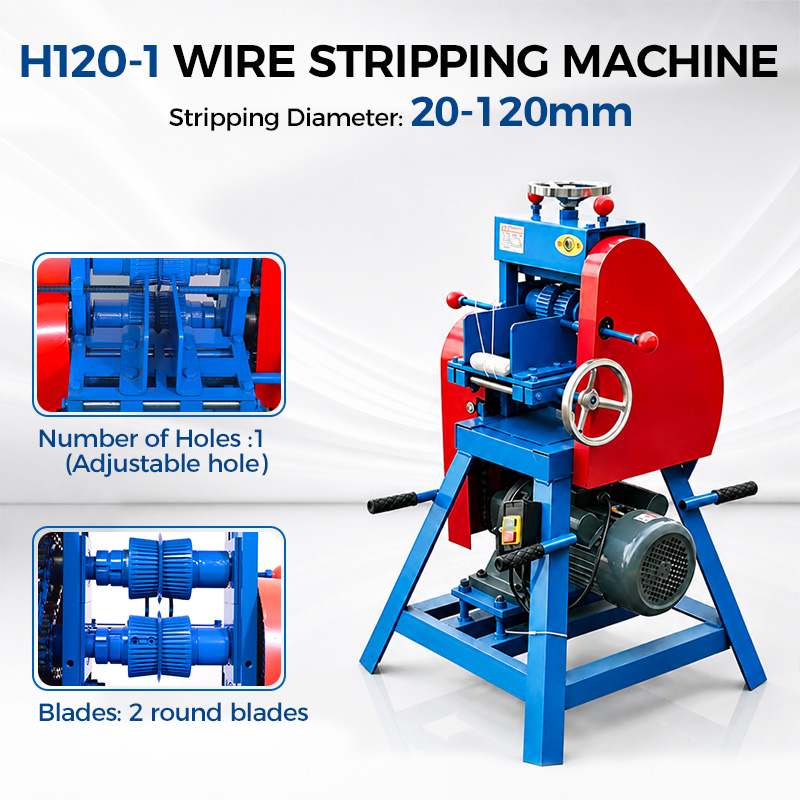
Adjustable Stripping for Large Power Cable
The Lansing H120-1 is a powered cable stripping machine for large scrap electrical cables from 20–120 mm in outside diameter. A 3kW geared motor drives the feeding mechanism, while one adjustable opening and two circular blades provide a focused setup for larger cable sizes.
Designed for thick power cable and suitable armored cable constructions, the H120-1 opens cable coverings for subsequent removal and metal recovery.
Key Selling Points
H120-1 20–120mm Automatic Armored Cable Stripping Machine — Product Description
LANSING MACHINERY presents the H120-1 20–120mm Automatic Armored Cable Stripping Machine, an industrial-grade solution designed to transform armored cable recycling operations with speed, precision, and reliability. Engineered for heavy-duty waste cable processing, this armored cable stripper redefines productivity in automatic cable recycling workflows. LANSING MACHINERY leverages deep experience in metal salvage equipment and waste cable processing to deliver a machine that excels in extracting valuable copper, aluminum, and ferrous components from armored cable jackets and sheaths while optimizing recovery rates and minimizing labor costs
Product Overview and Core Features
The H120-1 automatic armored cable stripping machine is purpose-built to handle a broad range of cable diameters from 20mm to 120mm. This versatile armored cable stripper supports high-throughput automatic cable recycling operations by combining robust mechanical design, precise control systems, and user-friendly interfaces
Key features include:
- Wide diameter compatibility: supports 20–120mm cable sizing, enabling one armored cable stripper to process a diverse inventory of armored and sheathed cables
- Automatic feeding and cutting: integrated conveyors and feed rollers provide steady automatic cable recycling operation, ensuring consistent positioning for precise sheath removal
- Adjustable stripping depth and speed: programmable control allows operators to optimize the automatic cable recycling cycle for different cable constructions, reducing conductor damage and improving recovery quality
Technical Innovations and Advantages
LANSING MACHINERY designed the H120-1 armored cable stripper with specific innovations to address common challenges in automatic cable recycling and waste cable processing. These innovations produce measurable advantages in recovery rates, operational efficiency, and equipment longevity
Precision Stripping Mechanism
The H120-1 employs a multi-stage stripping system that combines adjustable rotary cutters with synchronized peeling arms. This precision stripping mechanism minimizes conductor nicking while ensuring full separation of dense armoring and inner jackets. For automatic cable recycling operations aiming for high-purity copper reclamation, this results in fewer contaminants and higher downstream metal value
Adaptive Control System
A programmable control suite provides adaptive management of feed speed, cutter rotation, and stripping depth. By storing process presets for common cable types, the automatic cable recycling workflow can switch between jobs rapidly, reducing setup time and operator intervention
Durable Build for Continuous Operation
Recognizing that metal salvage equipment sees intense use, LANSING MACHINERY engineered the H120-1 with hardened steel components, reinforced drives, and heavy-duty bearings. This construction supports continuous operation in high-volume automatic cable recycling environments and lowers the total cost of ownership by minimizing unplanned downtime
Operational Benefits and ROI
Operators of the H120-1 armored cable stripper will realize tangible benefits across labor, throughput, and material recovery:
- Reduced labor and handling: automatic feeding and stripping reduce manual labor requirements compared to manual peeling, allowing staff to oversee multiple processes simultaneously
1. A 20–120 mm Working Range
Handle large electrical cables beyond the diameter limits of Lansing’s smaller multi-hole stripping machines.
2. One Adjustable Feed Opening
Set the opening to the cable being processed instead of selecting from fixed-size holes.
3. Two Circular Cutting Blades
The blade arrangement opens suitable cable coverings for subsequent peeling and material separation.
4. 3kW Geared Drive
The geared motor delivers reduced-speed drive to the feeding mechanism for large-cable processing.
5. Handwheel Adjustment
Handwheels provide mechanical adjustment for matching the feed and cutting setup to the material.
6. Grooved Feeding Rollers
Roller grooves help maintain cable grip during feeding. Correct setup and cable support remain essential.
7. Chain Transmission and Hardened Blades
Chain transmission transfers drive power, while hardened cutting components support repeated stripping work.
8. Floor-Standing Support Frame
The 126 kg machine provides a dedicated working structure for cable recycling operations.
| Specification | H120-1 |
| Machine Type | Automatic Large-Cable Stripping Machine |
| Cable Outside Diameter | 20–120 mm |
| Motor | 3kW Geared Motor |
| Feed Openings | 1 Adjustable Opening |
| Cutting Blades | 2 Circular Blades |
| Adjustment | Handwheel Adjustment |
| Transmission | Chain Drive |
| Feeding Rollers | Grooved Rollers |
| Dimensions — L × W × H | 750 × 600 × 1050 mm |
| Dimensions — Inches | Approximately 29.5 × 23.6 × 41.3 in |
| Machine Weight | 126 kg |
| Reference Daily Input | 800–2000 kg |
| Voltage Options | 220V / 380V, Configurable |
The working range refers to cable outside diameter, including insulation.
Daily input is a reference weight of incoming cable, not recovered copper weight. Actual output depends on cable construction, preparation, machine setup, operator handling, and working hours.
Four Steps for Large-Cable Stripping
1. Inspect the Cable Construction
Check outside diameter, jacket thickness, armor type, and internal core arrangement. Process only disconnected scrap cable that has been verified safe to handle.
2. Adjust the Opening and Cutting Depth
Disconnect machine power before setup. Match the opening and blade position to the intended layer according to the operating manual.
3. Test a Short Section
Support the cable and run a short trial with guards in place. Inspect the cut before continuing or adjusting the setup.
4. Process and Separate the Layers
Continue with the checked settings. Remove opened coverings and sort the recovered materials. Repeat processing only where appropriate for the cable and machine configuration.
Stop and disconnect power before clearing jams or making adjustments. Support long or heavy cable so its weight does not pull against the feed path.
Large Power Cable
Thick scrap electrical cable within the 20–120 mm outside-diameter range.
Suitable Armored Cable
Armored cable constructions matched to the machine’s cutting configuration and intended stripping stage. Armor material and thickness require assessment.
Decommissioned High-Voltage Cable
Retired power cable prepared for recycling after disconnection and verification that it is safe to handle.
Large Multi-Core Cable
Suitable cables requiring outer-covering removal to access internal cores. Individual core insulation may require further processing.
Cable Offcuts from Replacement Projects
Sorted large-diameter cable lengths generated during electrical infrastructure renewal and equipment dismantling.
Material Compatibility
Outside diameter alone does not establish suitability. Jacket material, metallic layers, insulation thickness, fillers, and conductor arrangement determine the appropriate setup and processing sequence.
What cable sizes can the H120-1 process?
The specified range is 20–120 mm in outside diameter. It is intended for larger cable rather than fine electrical wire.
Why does it have only one feed opening?
The opening is adjustable. It is set to the incoming cable instead of providing multiple fixed-size feeding holes.
How many blades does it use?
The specification lists two circular blades. Their cutting position must be set according to the cable and the layer being opened.
Can it process armored cable?
The H120-1 is positioned for suitable armored cable applications. Compatibility depends on armor material, thickness, cable structure, and cutting configuration. The 120 mm diameter limit is not a universal armor-cutting specification.
Does it strip all cable layers in one pass?
Not necessarily. Outer jackets, metallic armor, bedding, and core insulation may require separate removal stages.
Can it process high-voltage cable?
It can be used for suitable decommissioned high-voltage cable prepared as scrap. This does not mean the machine can work on energized cable.
Can it strip cables smaller than 20 mm?
They are outside the stated working range. Smaller-wire processing should use a model designed for those diameters.
How does it differ from the F70?
The F70 covers 1–72 mm with multiple feeding positions. The H120-1 covers 20–120 mm with one adjustable opening, focusing on larger cable and suitable armored constructions.
Is 2000 kg per day guaranteed?
No. The 800–2000 kg daily input is a reference range. Material construction, preparation, repeated passes, peeling, and working hours affect actual output.
Does stripping produce copper granules?
No. The machine opens coverings for removal. It does not granulate the conductor into copper particles.
What power supply is required?
The specification lists configurable 220V and 380V options. Voltage, frequency, phase, and circuit capacity must match the delivered machine.
How much workspace is needed?
The machine measures 750 × 600 × 1050 mm. Additional space is required for cable support, operator access, and collection of removed layers.
What maintenance is required?
Inspect blades, rollers, adjustment mechanisms, transmission, and fasteners according to the machine manual. Disconnect power before maintenance and replace all guards before operation.
Adjustable Stripping for Large Power Cable
The Lansing H120-1 is a powered cable stripping machine for large scrap electrical cables from 20–120 mm in outside diameter. A 3kW geared motor drives the feeding mechanism, while one adjustable opening and two circular blades provide a focused setup for larger cable sizes.
Designed for thick power cable and suitable armored cable constructions, the H120-1 opens cable coverings for subsequent removal and metal recovery.
Key Selling Points


 EN