
f60-2-160mm-dual-blade-cable-stripping-machine-with-geared-motor, f60-2-160mm-dual-blade-cable-stripping-machine-with-geared-motor, /wire-stripping-machine
EN
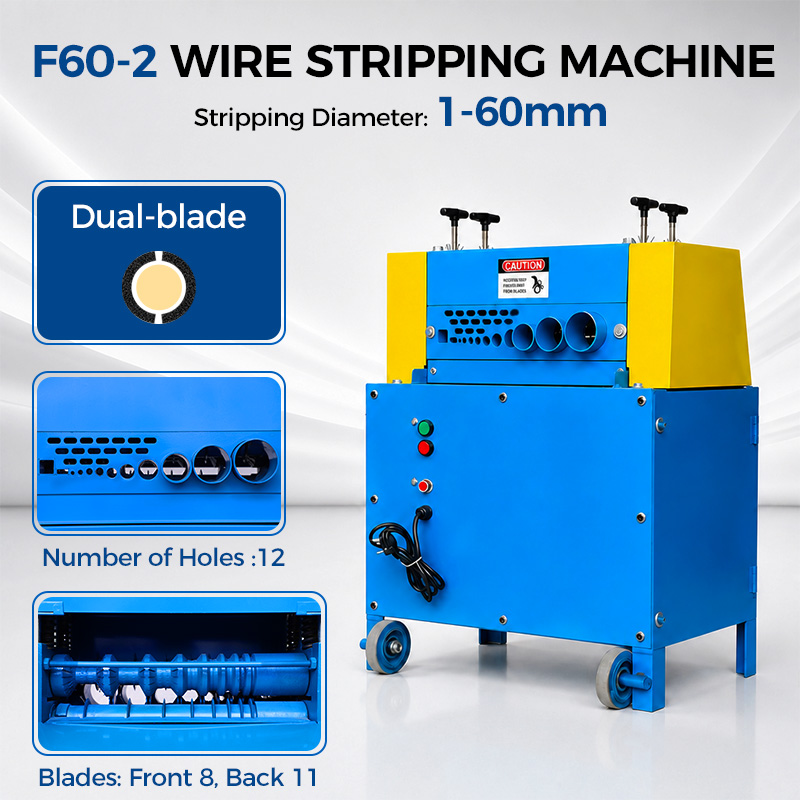
Geared Power for Everyday Cable Recycling
The Lansing F60-2 is a floor-standing electric wire stripping machine in the household recycling series. It combines a 2.2kW geared motor with chain transmission and a double-blade stripping configuration for suitable insulated cables from 1–60 mm in outside diameter.
Multiple stripping positions accommodate different cable sizes, while the narrow cabinet-style body and wheels support practical placement within a home recycling workshop.
Key Selling Points
12 Panel Openings · 19 Blades Total · 450 mm Machine Width
LANSING MACHINERY presents the F60-2 1–60mm Dual-Blade Cable Stripping Machine with Geared Motor, a robust and efficient solution engineered for modern recycling facilities and e-waste processing operations. This dual-blade cable stripper design enhances throughput and precision across a wide range of cable diameters, providing a versatile geared motor cable stripper that addresses the demands of both small-scale workshops and large industrial recyclers
Product Overview
The F60-2 1–60mm Dual-Blade Cable Stripping Machine with Geared Motor is built to handle insulated cables from 1 mm up to 60 mm in diameter. The machine’s dual-blade cable stripper configuration ensures simultaneous, clean removal of outer insulation layers, while minimizing conductor damage. Powered dual-blade cable stripper by a high-performance geared motor, this geared motor cable stripper delivers consistent torque and speed control, enabling operators to adapt to various materials and cable constructions
Applications
The F60-2 addresses a broad spectrum of cable stripping needs across industries. Recycling centers focused on sustainable e-waste processing will find the dual-blade cable stripper particularly advantageous for large volumes of cable waste. Scrap metal dealers benefit from rapid, high-yield dual-blade cable stripper of copper and aluminum conductors, while electronics dismantlers can use the geared motor cable stripper to prepare materials for further mechanical and chemical recovery processes
Operational Benefits
- Higher recovery rates: The dual-blade cable stripper provides superior insulation removal with minimal conductor damage, maximizing copper and aluminum recovery
- Faster processing: The geared motor cable stripper maintains consistent feed speeds and torque, enabling faster throughput compared to manually adjusted or belt-driven alternatives
- Improved consistency: Automation and precise controls reduce variability in stripping quality, essential for downstream material separation and resale value
- Lower operating costs: Durable construction and reduced maintenance intervals lower total cost of ownership for recycling facilities adopting the F60-2
Why LANSING MACHINERY
As a provider of reliable recycling equipment and customized solutions for waste cables and metals, Hangzhou Lansing Machinery Co., Ltd. combines integrated manufacturing, R&D, and global sales to offer end-to-end support. The F60-2 1–60mm Dual-Blade Cable Stripping Machine with Geared Motor reflects LANSING MACHINERY’s commitment to quality engineering and customer-focused service
1. A 1–60 mm Working Range
Process suitable electrical wires and larger insulated cable within one machine’s specified range.
2. 2.2kW Geared Motor
The geared drive combines speed reduction with torque delivery to the feeding mechanism. Actual performance depends on the complete drive system and incoming cable.
3. Chain Transmission
An engaged chain-and-sprocket arrangement transfers power to the feeding system. Correct tension, alignment, and maintenance support reliable operation.
4. Copper-Wound Motor
The motor uses copper windings, as identified in the product specification. Match the supplied electrical configuration to the installation requirements.
5. Double-Blade Stripping Configuration
The cutting arrangement helps open suitable cable insulation for removal. Select the appropriate stripping position and test the cutting depth before batch processing.
6. Multiple Stripping Positions
The panel includes ten round wire-stripping holes and one square wire-stripping hole, providing positions for different cable sizes and profiles.
7. Nineteen-Blade Layout
Eight front blades and eleven rear blades serve the cutting positions across the machine.
8. Narrow Cabinet with Wheels
The 450 mm-wide body provides a compact installation format. Wheels assist with repositioning the 121 kg machine, which must be secured against movement during operation.
Four Steps for Consistent Stripping
1. Check and Sort the Cable
Identify the outside diameter, insulation thickness, and conductor construction. Group similar materials and select a suitable stripping position.
2. Prepare the Machine
Position the machine on firm, level ground and secure it against movement. Disconnect power before adjusting the cutting setup according to the machine manual.
3. Test a Short Length
Keep guards in place and process a sample. Inspect the insulation opening and conductor surface before continuing.
4. Process and Separate
Use the checked setup for the batch. Remove opened insulation as needed and collect the conductor and covering separately.
Recheck the settings when cable construction changes. Stop and disconnect power before clearing jams, adjusting blades, or inspecting the drive system.
Electrical Installation Cable
Suitable insulated copper wires and cable offcuts generated during wiring, renovation, and electrical maintenance.
Larger Non-Armored Cable
Suitable insulated copper cable within the 1–60 mm range, subject to jacket thickness and conductor construction.
Appliance and Equipment Cable
Suitable power cables and electrical wiring collected during repair, replacement, or dismantling.
Flexible and Stranded Copper Wire
Suitable conductors requiring careful feed-position selection and cutting-depth adjustment to limit strand damage.
Sorted Home Recycling Batches
Electrical scrap organized by diameter and construction for more consistent feeding and cutting.
Material Compatibility
Cable diameter alone does not determine suitability. Insulation hardness, jacket structure, conductor arrangement, and feeding behavior also matter.
Multi-core cable requires assessment of the outer jacket and individual cores. Armored cable requires equipment designed for that construction.
What cable diameter can the F60-2 process?
The specified range is 1–60 mm in outside diameter, including insulation. This is not a conductor cross-sectional rating in mm².
What distinguishes F60-2 from F60-1?
Both have a specified 1–60 mm range. The F60-2 combines a 2.2kW geared motor with chain transmission and a narrower cabinet. The F60-1 lists a 3kW motor and a different machine layout.
Does the 2.2kW rating mean it is weaker than the 3kW F60-1?
Motor wattage alone does not determine feeding capability. Gear ratio, transmission, feeding geometry, and cable characteristics also affect performance.
What is the purpose of the geared motor?
Gear reduction lowers rotational speed while increasing available output torque, subject to transmission losses. The actual feeding force depends on the complete mechanism.
Does chain drive guarantee that cable will never slip?
No. Chain transmission transfers power through engaged sprockets, but cable grip still depends on the feeding components, pressure, setup, and material condition.
How many blades does the F60-2 have?
The specification lists eight front blades and eleven rear blades, giving 19 blades in total. “Double-blade” describes the stripping configuration.
How many stripping openings are available?
The panel has 12 openings in total. Ten round holes and one square hole are identified for wire stripping. Use each opening according to its designated function in the machine instructions.
Is the insulation removed fully automatically?
Feeding and cutting are motorized. The operator still prepares and introduces the cable, and additional peeling may be required after cutting.
Is 1000 kg per day guaranteed?
No. The listed 500–1000 kg daily input is a reference range for incoming cable. Actual output varies with material, setup, handling, and working hours.
Can it process multi-core cable?
Some constructions may be suitable for outer-jacket stripping. Opening the jacket does not automatically remove insulation from each internal core.
What power supply is required?
The specification lists configurable 110V, 220V, and 380V options. Voltage, frequency, phase, and circuit capacity must match the delivered machine.
What maintenance does the chain drive need?
Follow the machine manual for chain inspection, tension, alignment, and lubrication. Disconnect power before accessing the transmission and reinstall guards before operation.
How much workspace is needed?
The machine measures 640 × 450 × 860 mm. Allow additional space for feeding long cable, operator access, and collecting processed material.
Compare Lansing Household Wire Strippers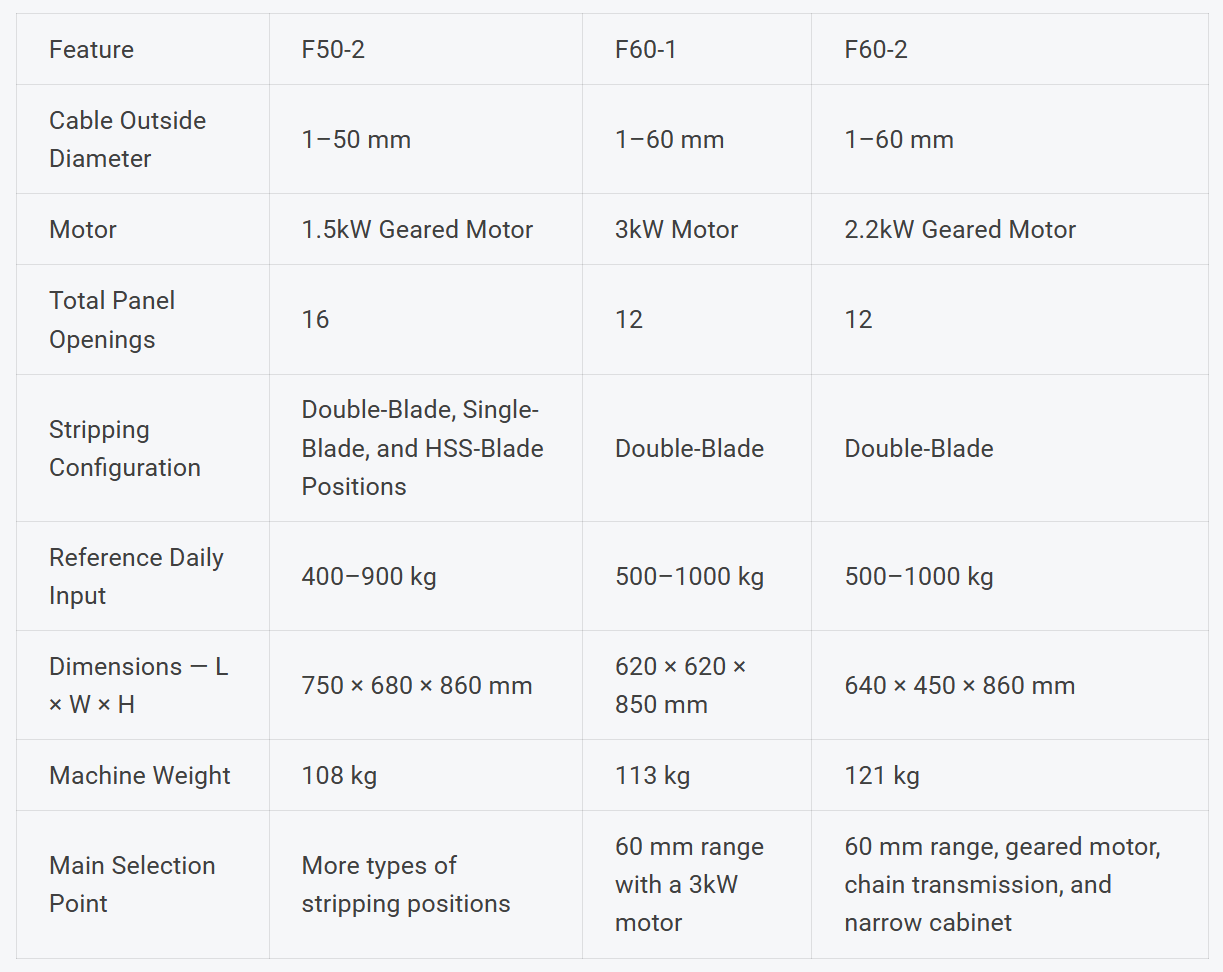
Where the F60-2 Fits
The F60-2 suits home recycling workshops seeking a 1–60 mm cable range with a geared drive and narrow installation width. Its chain transmission and cabinet layout distinguish it within the F60 range.
The best match depends on cable construction, feeding behavior, electrical supply, and available workspace. Motor power and reference daily input should be considered alongside these factors.
Geared Power for Everyday Cable Recycling
The Lansing F60-2 is a floor-standing electric wire stripping machine in the household recycling series. It combines a 2.2kW geared motor with chain transmission and a double-blade stripping configuration for suitable insulated cables from 1–60 mm in outside diameter.
Multiple stripping positions accommodate different cable sizes, while the narrow cabinet-style body and wheels support practical placement within a home recycling workshop.
Key Selling Points
12 Panel Openings · 19 Blades Total · 450 mm Machine Width


 EN