
f60-1-160mm-3kw-automatic-wire-stripping-machine, f60-1-160mm-3kw-automatic-wire-stripping-machine, /wire-stripping-machine
EN
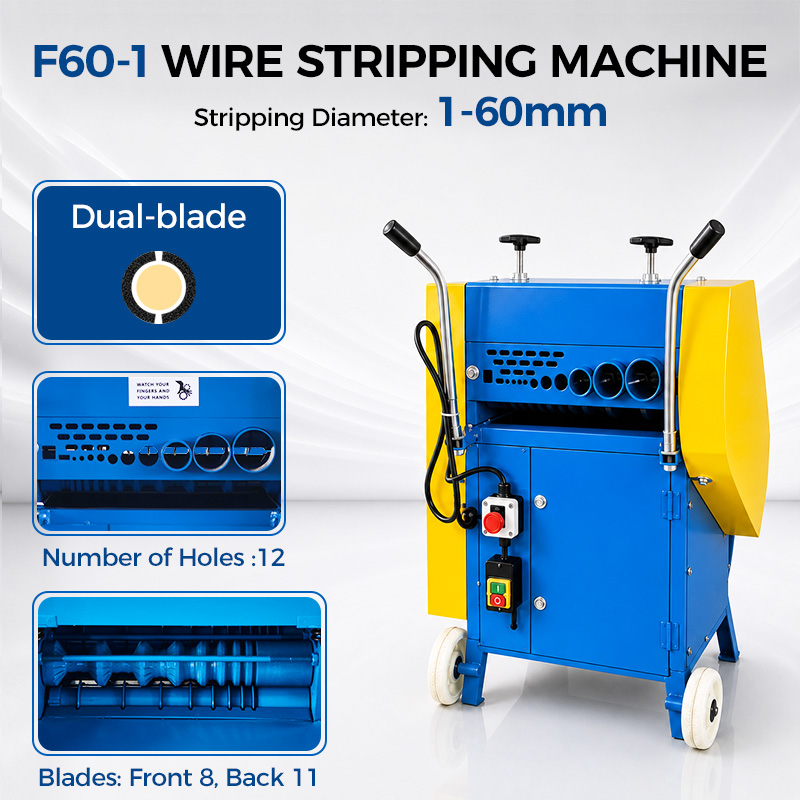
A Wider Cable Range for Home Copper Recovery
The Lansing F60-1 is a floor-standing automatic wire stripping machine in the household recycling series. Designed for suitable insulated cables from 1–60 mm in outside diameter, it combines a 3kW motor with a double-blade stripping configuration to open insulation for copper recovery.
Multiple feeding positions accommodate different cable sizes, while the wheeled frame allows the machine to be repositioned within the workspace.
Key Selling Points
19 Blades Total · 113 kg Machine Weight · Floor-Standing Design
LANSING MACHINERY presents the F60-1 1–60mm 3kW Automatic Wire Stripping Machine, a high-performance solution engineered for modern recycling operations requiring precision, throughput, and reliability. The F60-1 wire stripping machine is designed to meet the needs of industrial users, recycling centers, and metal recovery businesses that demand consistent results and minimal downtime
The F60-1 wire stripping machine is built around a 3kW wire stripping powertrain that provides smooth, dependable torque for cutting and stripping insulated conductors. The 3kW wire stripping motor delivers the force necessary to process cables ranging from 1 mm to 60 mm in diameter. As an automatic wire stripper, the F60-1 features automated feed, cutting, and peel cycles that remove insulation cleanly while preserving core conductor integrity
The F60-1 wire stripping machine is ideal for cable recycling facilities, electronic waste processors, metal recovery plants, and municipal recycling centers. As an automatic wire stripper, the F60-1 processes mixed cable loads recovered from demolition, scrap yards, and consumer electronics recycling
Recognizing that cable recycling requirements vary widely, the F60-1 wire stripping machine supports customization and optional configurations. LANSING MACHINERY automatic wire stripper provides tailored blade sets, feed rollers, and control packages to match specific cable profiles, material mixes, and production targets
Hangzhou Lansing Machinery Co., Ltd. provides one-stop support from design to after-sales, ensuring the F60-1 automatic wire stripper can be integrated into existing cable recycling equipment lines and material handling systems. As part of the company’s commitment to reliable recycling equipment, LANSING MACHINERY automatic wire stripper offers installation guidance, remote and onsite technical support, spare parts, and preventative maintenance programs
1. A 1–60 mm Working Range
Process suitable insulated cable up to 60 mm in outside diameter, extending the range available in Lansing’s household stripping series.
2. 3kW Electric Drive
The motor powers cable feeding through the cutting section, reducing manual effort when processing repeated cable lengths.
3. Double-Blade Stripping Configuration
The cutting arrangement helps open insulation for peeling on suitable cable constructions. A short trial establishes the appropriate setup.
4. Multiple Feeding Positions
The 12-opening panel includes ten round wire-stripping holes and one square wire-stripping hole, providing positions for different cable sizes and profiles.
5. Nineteen-Blade Layout
Eight front blades and eleven rear blades serve the machine’s cutting positions. This is the total blade count across the assembly.
6. Adjustable Cutting Setup
Match the blade setting to insulation thickness and conductor construction. Correct adjustment helps open the covering without cutting unnecessarily into the metal.
7. Compact Floor-Standing Structure
A 620 × 620 mm base provides a defined installation footprint without requiring a separate workbench.
8. Wheels for Workspace Repositioning
Wheels assist with moving the machine into position. Its 113 kg weight requires appropriate handling, and the machine must be secured against movement during operation.
| Specification | F60-1 |
| Product Series | Household Wire Stripping Series |
| Machine Type | Floor-Standing Automatic Wire Stripper |
| Stripping Configuration | Double-Blade |
| Cable Outside Diameter | 1–60 mm |
| Motor Power | 3kW |
| Total Panel Openings | 12 |
| Identified Wire-Stripping Openings | 10 Round + 1 Square |
| Additional Opening | 1 |
| Front Blades | 8 |
| Rear Blades | 11 |
| Total Blade Count | 19 |
| Dimensions — L × W × H | 620 × 620 × 850 mm |
| Dimensions — Inches | Approximately 24.4 × 24.4 × 33.5 in |
| Machine Weight | 113 kg |
| Reference Daily Input | 500–1000 kg |
| Voltage Options | 110V / 220V / 380V, Configurable |
| Mobility | Wheels for Repositioning |
The working range refers to cable outside diameter, including insulation.
Daily input is a reference weight of incoming cable, not recovered copper weight. Actual performance depends on material, setup, cable preparation, operator handling, and working hours.
Four Steps for Consistent Cable Stripping
1. Check and Sort the Material
Measure the cable’s outside diameter and identify its construction. Group similar cables together and select a suitable stripping position.
2. Prepare the Cutting Setup
Position the machine on firm, level ground and secure it against movement. Disconnect power before adjusting the cutting depth according to the machine manual.
3. Inspect a Short Trial
Process a short cable length and check the insulation opening and conductor surface. Stop and disconnect power before correcting an unsuitable setting.
4. Process and Separate
Continue with the checked setup. Remove opened insulation as needed and collect the conductor and covering separately.
Support incoming cable appropriately and keep the feeding and collection areas clear. Disconnect power before clearing jams, cleaning, or servicing.
Electrical Installation Cable
Suitable insulated copper wires and cable offcuts collected during wiring, renovation, and electrical maintenance.
Larger Non-Armored Copper Cable
Suitable cable within the 1–60 mm outside-diameter range, subject to insulation and conductor construction.
Appliance and Equipment Cable
Suitable electrical cable generated during equipment repair, replacement, or dismantling.
Flexible and Stranded Copper Wire
Suitable conductors requiring careful feed-position selection and blade adjustment to open insulation while limiting strand damage.
Sorted Home Recycling Batches
Electrical scrap grouped by diameter and construction for more consistent feeding and stripping.
Material Compatibility
A cable’s outside diameter does not determine suitability on its own. Jacket thickness, insulation hardness, conductor structure, and feeding behavior also matter.
Multi-core cable requires assessment of both the outer jacket and internal cores. Armored cable requires equipment designed for its construction.
What is the main difference between F60-1 and the F50 models?
The F60-1 extends the specified cable range from 1–50 mm to 1–60 mm and uses a 3kW motor. The F50-1 and F50-2 have different motor ratings and feeding layouts.
Does the 60 mm limit refer to the copper conductor?
No. It refers to the cable’s outside diameter, including insulation. It is not a conductor cross-sectional rating in mm².
How many blades does the F60-1 have?
The specification lists eight front blades and eleven rear blades, giving 19 blades in total.
Why is it called double-blade if it has 19 blades?
Double-blade describes the stripping configuration. The total blade count includes blades serving different cutting positions across the machine.
How many feeding openings are available?
The panel has 12 openings in total. The specification identifies ten round wire-stripping holes and one square wire-stripping hole. Use each opening only for its designated purpose in the machine instructions.
Does it completely remove insulation automatically?
Feeding and cutting are motorized. The operator still prepares and introduces the cable, and some materials require additional peeling after cutting.
Is 1000 kg per day guaranteed?
No. The listed 500–1000 kg daily input is a reference range. Actual performance depends on the cable, preparation, handling, and working hours.
Can it strip every cable smaller than 60 mm?
No. Cable construction and insulation characteristics also determine compatibility. Metal armor, complex jackets, and unusual materials require separate assessment.
Can it process multi-core cable?
Some constructions may be suitable for outer-jacket stripping. Opening that jacket does not automatically remove insulation from the individual internal cores.
Does the 3kW motor guarantee faster stripping than a smaller model?
Motor power alone does not determine processing speed or finished output. The feeding mechanism, blade setup, cable characteristics, and operator handling all contribute.
Compare Lansing Household Wire Strippers
| Feature | F50-1 | F50-2 | F60-1 |
| Cable Outside Diameter | 1–50 mm | 1–50 mm | 1–60 mm |
| Motor | 2.2kW | 1.5kW Geared Motor | 3kW |
| Total Panel Openings | 13 | 16 | 12 |
| Stripping Configuration | Double-Blade | Double-Blade, Single-Blade, and HSS-Blade Positions | Double-Blade |
| Reference Daily Input | 400–1000 kg | 400–900 kg | 500–1000 kg |
| Dimensions — L × W × H | 620 × 550 × 850 mm | 750 × 680 × 860 mm | 620 × 620 × 850 mm |
| Machine Weight | 100 kg | 108 kg | 113 kg |
| Main Selection Point | 50 mm range with 2.2kW drive | Geared drive and varied stripping positions | Wider 60 mm range with 3kW drive |
Where the F60-1 Fits
The F60-1 is suited to home recycling workshops that need to process suitable cables beyond the F50 models’ 50 mm limit. Its 1–60 mm range, 3kW motor, and double-blade configuration provide a wider material-handling option within Lansing’s household series.
For cables within 50 mm, compare the required cutting arrangement and feeding positions as well as motor power. Reference daily input figures should be assessed against the actual material and working conditions.
A Wider Cable Range for Home Copper Recovery
The Lansing F60-1 is a floor-standing automatic wire stripping machine in the household recycling series. Designed for suitable insulated cables from 1–60 mm in outside diameter, it combines a 3kW motor with a double-blade stripping configuration to open insulation for copper recovery.
Multiple feeding positions accommodate different cable sizes, while the wheeled frame allows the machine to be repositioned within the workspace.
Key Selling Points
19 Blades Total · 113 kg Machine Weight · Floor-Standing Design


 EN