
f50-2-150mm-geared-automatic-wire-stripping-machine, f50-2-150mm-geared-automatic-wire-stripping-machine, /wire-stripping-machine
EN
More Stripping Positions for Mixed Scrap Wire
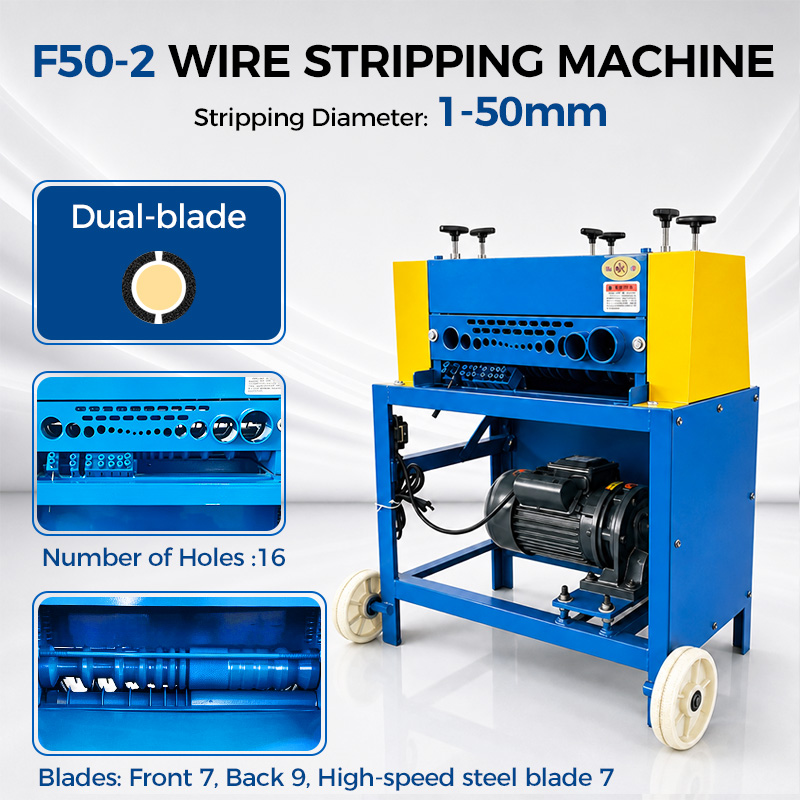
The Lansing F50-2 is a floor-standing electric wire stripping machine in the household recycling range. It combines a 1.5kW geared motor with 16 feeding positions for suitable insulated cables from 1–50 mm in outside diameter.
Seven double-blade positions, two single-blade positions, and seven positions equipped with high-speed steel blades provide different cutting options for sorted scrap wire. The wheeled frame supports practical positioning within a home recycling workshop.
Key Selling Points
Floor-Standing Design · 108 kg Machine Weight · Wheels for Repositioning
LANSING MACHINERY presents the F50-2 1–50mm Geared Automatic Wire Stripping Machine, a high-performance solution engineered for efficient, reliable, and scalable cable recycling operations. Designed for labor-saving productivity and optimized scrap handling, this machine represents a breakthrough in automatic wire stripper technology, delivering precision, robustness, and adaptability for a wide range of industrial and commercial scrap wire processing needs. Built for processors who demand consistent yields and low downtime, the F50-2 automatic wire stripper sets a new standard in geared cable recycling equipment
The F50-2 is a geared automatic wire stripper engineered to process conductor diameters from 1 mm to 50 mm with unmatched precision. Its geared drive system provides steady torque and controlled feed rates, enabling repeatable results across mixed wire batches
Engineered for throughput and consistency, the F50-2 automatic wire stripper accelerates processing rates with smooth, continuous operation. The automatic wire stripper geared mechanics ensure that feed speed and stripping action remain synchronized even under heavy loads, which automatic wire stripper improves yield recovery and lowers reject rates
User-centric design is central to the F50-2’s appeal. The automatic wire stripper machine features intuitive adjustment mechanisms for blade depth, feed speed, and roller pressure, enabling rapid setup for varying cable diameters from 1 mm to 50 mm
The F50-2 prioritizes operator safety with guarded moving parts, emergency stop features, and compliant electrical isolation. Dust and particulate management options can be integrated to address environmental control needs during intensive scrap wire processing campaigns
Hangzhou Lansing Machinery Co., Ltd. offers comprehensive integration support for the F50-2 automatic wire stripper, including site assessment, process design, and after-sales service. With in-house manufacturing, R&D, and global sales capabilities
Investing in the F50-2 geared automatic wire stripper reduces manual labor costs, increases metal recovery rates, and shortens cycle times for scrap wire processing. By improving yield and lowering labor and maintenance expenses, the F50-2 automatic wire stripper contributes to faster return on investment for recycling operations
1. Sixteen Feeding Positions
Multiple openings provide a choice of feed paths for different wire sizes, helping organize the processing of sorted cable batches.
2. 1.5kW Geared Drive
The motor uses gear reduction to deliver power to the feeding mechanism. Motor wattage alone does not describe the available feeding torque or actual stripping performance.
3. Seven Double-Blade Positions
These positions use a double-blade cutting arrangement to help open insulation on suitable cable constructions.
4. Two Single-Blade Positions
Additional single-blade positions provide an alternative cutting arrangement for cables matched to those openings.
5. Seven HSS-Blade Positions
Seven feeding positions are equipped with high-speed steel blades, adding a distinct cutting option within the same machine.
6. A 1–50 mm Working Range
Process suitable insulated wire across a broad diameter range, including electrical installation offcuts and larger cable lengths within the specified limit.
7. Adjustable Cutting Setup
Match the cutting depth and feed position to the insulation. Correct adjustment helps open the covering while limiting unnecessary contact with the conductor.
8. Floor-Standing Wheeled Frame
The machine provides its own support structure and wheels for repositioning. Its 108 kg weight requires appropriate handling and a secure operating position.
| Specification | F50-2 |
| Product Series | Household Wire Stripping Series |
| Machine Type | Floor-Standing Automatic Wire Stripper |
| Cable Outside Diameter | 1–50 mm |
| Motor | 1.5kW Geared Motor |
| Total Feed Positions | 16 |
| Double-Blade Positions | 7 |
| Single-Blade Positions | 2 |
| HSS-Blade Positions | 7 |
| Front Blade Count | 7 |
| Rear Blade Count | 9 |
| Listed High-Speed Steel Blades | 7 |
| Dimensions — L × W × H | 750 × 680 × 860 mm |
| Dimensions — Inches | Approximately 29.5 × 26.8 × 33.9 in |
| Machine Weight | 108 kg |
| Reference Daily Input | 400–900 kg |
| Voltage Options | 110V / 220V / 380V, Configurable |
| Mobility | Wheels for Repositioning |
The working range refers to cable outside diameter, including insulation.
Daily input is a reference weight of incoming cable, not recovered copper weight. Actual performance depends on material, setup, cable preparation, operator handling, and working hours.
Four Steps for Consistent Cable Stripping
1. Sort and Measure
Group cables by outside diameter and construction. Check that the material falls within the specified working range.
2. Select and Adjust
Disconnect power before setup. Choose the appropriate stripping position and adjust the cutting depth according to the machine manual and insulation thickness.
3. Test the Result
Process a short sample and inspect the insulation opening and conductor. Stop and disconnect power before correcting the setup.
4. Process the Batch
Continue with the checked settings, remove opened insulation as needed, and collect the conductor and covering separately.
Position the machine on firm, level ground and secure it against movement. Keep the feeding and collection areas clear, and disconnect power before clearing jams or servicing.
Electrical Installation Wire
Suitable insulated copper wires and cable offcuts collected during wiring, renovation, and electrical maintenance.
Appliance and Equipment Cable
Suitable power cords and electrical cables generated during repair, replacement, or dismantling.
Flexible Copper Wire
Flexible insulated conductors that can be matched to an appropriate opening and cutting arrangement.
Stranded Copper Cable
Suitable stranded cables requiring careful blade adjustment to open insulation while limiting damage to individual strands.
Mixed-Size Scrap Batches
Electrical scrap sorted into groups by diameter and construction, then processed through suitable stripping positions.
Material Compatibility
Insulation hardness, jacket thickness, conductor structure, and feeding behavior all affect suitability. Multi-core cable requires assessment of the outer jacket and internal cores. Armored cable requires equipment designed for that construction.
What is the main difference between F50-2 and F50-1?
Both have a specified 1–50 mm working range. The F50-2 uses a 1.5kW geared motor and 16 feeding positions, including double-blade, single-blade, and HSS-blade positions. The F50-1 lists a 2.2kW motor and 13 openings.
Does the lower motor rating mean lower stripping performance?
Not necessarily. Gear reduction, feeding geometry, blade setup, and cable construction all affect performance. Motor power alone is not enough to compare the two machines.
How are the 16 feeding positions arranged?
The specification lists seven double-blade positions, two single-blade positions, and seven positions equipped with high-speed steel blades.
Does every feed opening process the full 1–50 mm range?
No. The range applies to the machine as a whole. Individual openings must be matched to the cable size and construction.
What does HSS mean?
HSS stands for high-speed steel. The F50-2 specification lists seven high-speed steel blades and seven associated feeding positions.
Are all 16 openings intended for simultaneous feeding?
The number describes the available feeding positions, not a simultaneous processing capacity. Follow the machine manual for the permitted feeding method.
Does the machine fully separate the insulation automatically?
Feeding and cutting are motorized. Additional peeling may be needed to separate the opened covering from the conductor.
What does 400–900 kg daily input represent?
It is a reference weight of incoming cable, including insulation. It is not a guaranteed production rate or the weight of recovered copper.
Can it strip multi-core cable?
Some constructions may be suitable for opening the outer jacket. This does not automatically remove the insulation around the individual internal cores.
Is the F50-2 a household-series machine?
Yes. It belongs to Lansing’s household wire stripping series. Its floor-standing design and electrical requirements should still be matched to the intended workspace.
Are 110V, 220V, and 380V available?
These are listed configuration options. The supplied machine must match the installation’s voltage, frequency, phase, and circuit capacity. Do not assume one machine switches between all three voltages.
Can the machine be moved easily?
Wheels assist with repositioning, but the machine weighs 108 kg. Appropriate handling is required for loading, transport, and movement across uneven surfaces.
What routine maintenance is needed?
Remove insulation scraps and inspect blades, feeding components, and fasteners according to the machine manual. Follow the specified lubrication requirements for the drive system and disconnect power before maintenance.
More Stripping Positions for Mixed Scrap Wire
The Lansing F50-2 is a floor-standing electric wire stripping machine in the household recycling range. It combines a 1.5kW geared motor with 16 feeding positions for suitable insulated cables from 1–50 mm in outside diameter.
Seven double-blade positions, two single-blade positions, and seven positions equipped with high-speed steel blades provide different cutting options for sorted scrap wire. The wheeled frame supports practical positioning within a home recycling workshop.
Key Selling Points
Floor-Standing Design · 108 kg Machine Weight · Wheels for Repositioning


 EN